AT&T, Verizon and Tillman
Infrastructure said they’ve reached a deal to build “hundreds” of cell
towers, in an arrangement the parties say is more cost-effective than
traditional tower lease deals.
Tension over traditional tower lease
arrangements has popped up in the past year during earnings calls and
other finance discussions with both towercos and the major carriers. In
Monday’s announcement, AT&T SVP Susan Johnson said, “We need more
alternatives to the traditional tower leasing model with the large
incumbents,” saying the current model “is not cost-effective or
sustainable.” Verizon Chief Network Officer
said the carrier is reviewing all of its long-term contracts as they
come up for renewal “and we are excited to develop new vendor partners
to diversify our infrastructure providers.”
Tillman owns and operates macro
towers, small cells and smart cities infrastructure; it will build these
towers to suit. AT&T and Verizon will lease the towers that will be
co-located and co-anchored by the two carriers. Construction is slated
to begin in the first quarter of 2018.
The carriers confirmed to Inside Towers the
deal is for macro towers only. Verizon said this is the first agreement
of its kind with another large carrier and tower company in its
history. AT&T told Inside Towers: “All of our desired site locations are being considered” with the Tillman agreement. Continue Reading

Written for the wireless tower industry.
Tuesday, November 14, 2017

Monday, November 13, 2017
Advisory Committee Tells FCC to Take Down Deployment Barriers


From left: Ajit Pai, Mignon Clyburn and Jonathan Adelstein at the FCC’s
Broadband Deployment Advisory Committee meeting. Photos by Leslie Stimson, Inside Towers
The FCC’s Broadband Deployment Advisory Committee is closer to issuing recommendations to the FCC on how to reduce several types of regulatory barriers to broadband infrastructure deployment. The advisory group approved several draft recommendations at its third meeting of the year last Thursday and they plan to approve final recommendations at the next meeting on January 22 and 23, 2018.
Several FCC Commissioners addressed the all-volunteer group. Chairman Ajit Pai told the group as they began their all-day meeting: “The internet is poles, cables and physical infrastructure. Building these networks is hard and the government shouldn’t make it harder. When you find answers” to eliminating “barriers to wired and wireless infrastructure access will grow. That’s why it’s important that we get this right.” Commissioner Mignon Clyburn said even when the group handles all of the obstacles to pole attachments and access to rights-of-way, they “may be tempted to celebrate,” but that would be premature, “obscuring a simple reality that not every broadband problem is an infrastructure problem. For all Americans to be truly connected we cannot ignore … affordability.”
WIA President Jonathan Adelstein chairs the Streamlining Federal Siting working group. Some 30 percent of the land in the U.S. is owned by the federal government and it’s often the last place infrastructure is sited due to varying and unpredictable fees and rates, lengthy application reviews and un-harmonized forms across agencies, to name a few reasons. “It’s a shame and we’re going to try to change that,” he said, noting the White House is supportive of the group’s efforts. “The administration wants to ensure implementation is consistent across all federal agencies.” Continue Reading
Wednesday, November 8, 2017
Pai Sees Tower Site, “Unimaginable” Damage in Puerto Rico

FCC Chairman Ajit Pai traveled to a mountaintop tower in eastern Puerto Rico this week to get a first-hand view of recovery efforts and damage caused by Hurricane Maria. He met with government officials and communications company representatives to learn what still needs to be done to restore communications.
Pai met personnel from carriers AT&T, Open Mobile, T-Mobile and Verizon as well as fixed wireless providers Aeronet and Neptuno Networks; wired providers like Claro/PRTC and Liberty and several radio broadcasters. “They have stepped up to the plate, working overtime to connect the disconnected,” he said.
Pai called the damage “unimaginable” and said: “I saw some of it for myself, from a mountaintop tower in El Yunque National Forest, which is hard to reach due to storm damage but is precariously operational, to destroyed homes in San Juan. The path to recovery has met several challenges, most notably the lack of power and functional infrastructure. One thing is clear: overcoming these challenges won’t be easy,” the Chairman added in Tuesday’s announcement. Continue Reading
Tuesday, November 7, 2017
Sprint Stock Takes a Hit as T-Mo Calls it Quits But Tower Stocks Jump

T-Mobile (NASDAQ: TMUS) and Sprint (NYSE: S) jointly said they ended talks to merge as the companies were unable to find mutually agreeable terms.
Sprint stock hit a new annual low of $5.81 this morning, and was last seen down 11.5 percent in its five day average as of close of business yesterday, after the telecom called off its merger with T-Mobile on Saturday. Masayoshi Son, CEO of Sprint parent Softbank, is confident Sprint can grow independently, but said the company would still consider a merger if its management rights are preserved.
Tower stocks on the other hand reached new highs as American Tower (NYSE:AMT) is up 5.6 percent over five days; SBA Communications (NASDAQ:SBAC) is up 6.4 percent over five days and Crown Castle’s (NYSE:CCI) five day average is up five percent. All three hit 52-week highs yesterday. Continue Reading
Monday, November 6, 2017
Even Buried Fiber No Match for CA Wildfires

During the infernos that blazed through Northern California in October, large areas of the region lost cell phone coverage and internet connectivity in the first few hours of the disaster, as Verizon and Comcast networks took a big hit. As the fires continued to rage on, as many as 77 towers were taken off the grid, despite swift reaction times from the providers, reported The Healdsburg Tribune. Even though Comcast and Verizon services were back up and running by October 10 and 11, respectively, there were still safety challenges for residents and emergency workers due to loss of connectivity.
During the fires, some emergency personnel used landlines to communicate since Verizon cell coverage was lacking. The Town of Windsor, for example, has 1,600 Verizon devices, including cell phones, tablets, and computers, according to County spokesman Scott Alonso.
“When the network went down we lost all our map data,” said Fire Prevention Officer Cyndi Foreman. “And visual landmarks weren’t any help, either.” Continue Reading
Friday, November 3, 2017
DOJ Ponders Antitrust Action on Time-Warner/AT&T Merger
 Time
Warner shares fell Thursday after a newspaper reported that the
Department of Justice is considering an antitrust lawsuit to block
AT&T’s acquisition of the media giant, according to a Wall Street Journal report yesterday.
Time
Warner shares fell Thursday after a newspaper reported that the
Department of Justice is considering an antitrust lawsuit to block
AT&T’s acquisition of the media giant, according to a Wall Street Journal report yesterday.Time Warner share price was down 4.1 percent after the Journal reported the department’s antitrust division is preparing for litigation in case it decides to sue to block the deal. At the same time, the department and the two companies are discussing possible terms that would allow the deal to receive the government’s approval, the Journal reported, citing people familiar with the matter.
AT&T representatives have met with Justice officials in recent weeks, and the department hasn’t made a final decision, but the two sides aren’t close to an agreement, the Journal’s sources said.
Continue Reading
Thursday, November 2, 2017
Opting-Out of FirstNet Means Taking the Risk and Paying the Price
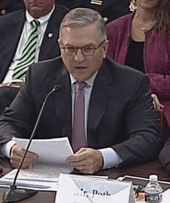

FirstNet’s Mike Poth (left), NH’s John Stevens. Photos by Leslie Stimson, Inside Towers.
As the December 28 deadline draws near for states to decide whether to opt-in or out of the First Responder Network Authority (FirstNet), just under half of the states have yet to make a decision. Oklahoma became the 26th state to opt-in yesterday. The questions and options facing undecided states about the financial ramifications of building their own mobile broadband network for first responders have increased and were on full display during yesterday’s hearing of the House Communications and Technology Subcommittee in Washington, D.C. (see related story below “What Happens When a State Opts-In to FirstNet?”)
Rep. Mike Doyle (D-PA) said, “A lot of hay has been made recently about the opt-out process” and “states seeking to opt-out seem overwhelmed” by the process. “The risks to opt-out are steep,” he said during the FirstNet oversight hearing. Continue Reading
Subscribe to:
Posts (Atom)