Thursday, September 28, 2017

TV Tower Crane Gives Way Killing Three


Three people working on the WSVN television transmission tower have died after the ginpole they were on collapsed in Miami Gardens, FL late Wednesday afternoon according to WSVN, the station that housed the tower.  Miami-Dade Fire Rescue responded to the scene at 501 NW 207 Street in Miami Gardens, at around 4 p.m.

The ginpole gave way, according to witnesses, killing three crew members hired by WSVN to work on the tower, which is shared with WPLG, WSVN reported. According to Miami-Dade Fire Rescue, the crew fell about 300 to 400 feet. WSVN said they had hired Tower King II out of Texas to do work on the tower. Continue Reading

Wednesday, September 27, 2017

Sparks Fly As Commissioners Debate Mobile Wireless Competition


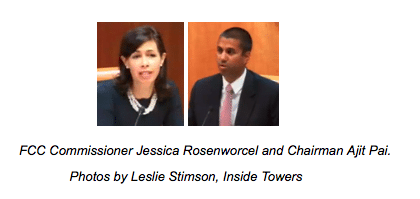
For much of yesterday’s FCC meeting, Commissioners agreed on many things, but when it came to the 20th Mobile Wireless Competition Report, the gloves came off. Republican Chairman Ajit Pai and his fellow GOP Commissioners Michael O’Rielly and Brendan Carr agreed the statistics from 2016 and early 2017 show there is effective competition in the wireless markets. The report makes interesting conclusions about tower site pricing as well.

O’Rielly said “nationwide providers are investing in infrastructure and fiercely competing for customers.” Carr agreed, adding: “Wireless prices are falling. Speeds are increasing. To get there, the FCC has to do its part, finding ways to drive down the regulatory costs of deploying fiber and small cells.” Getting this done is going to be one of his priorities, Carr said. Continue Reading

Tuesday, September 26, 2017

AT&T Creates Website to Help Locate People in Puerto Rico

 
AT&T continues to work around the clock to help the people of Puerto Rico recover from Hurricanes Maria and Irma. The company set up a website that will let anyone stateside (regardless of carrier) to register the cell phone number of a family member or friend who is an AT&T wireless customer in Puerto Rico. When the Puerto Rico-based customer’s cell phone connects to the AT&T network in Puerto Rico, the customer will be notified their family or friends in the U.S. have been trying to reach them.
 
The family member or friend who registered will also be notified through email when additional service in Puerto Rico has been restored. AT&T Communications CEO John Donovan said critical help began arriving over the weekend and more is on the way. He went with one of the relief flights into San Juan to help assess damage and develop recovery plans. More flights and ships carrying communications equipment and supplies are arriving in the coming days. The equipment includes generators, fuel and satellite devices for first responders as well as food, bottled water and personnel.  Continue Reading

Monday, September 25, 2017

Lowering Broadband Speed Threshold Proposal Draws Hundreds of Opinions

More than 1,600 public comments have poured into the FCC in response to the agency’s inquiry about broadband deployment. Inside Towers examined some of the comments concerning one controversial FCC proposal that calls for lowering the threshold speed for mobile broadband from the current 25 Megabits-per-second (Mbps) download speed and three Mbps upload speed, down to 10 Mbps download speed and one Mbps upload speed, to more closely match the current speeds subscribers are paying for.

That benchmark was “arbitrarily selected” based on a hypothetical family’s theoretical bandwidth requirements for simultaneous use of multiple devices engaged in bandwidth-intensive activities, according to USTelecom. “It would be disruptive for the Commission to change or eliminate the current benchmark without evidence that broadband at those speeds does not meet the need of consumers as they typically use broadband services today,” USTelecom told the Commission, urging no change to the standard.  

ITTA – The Voice of America’s Broadband Providers, agrees, saying the FCC should maintain the current speed thresholds for fixed broadband. Changing it would be confusing and if replaced often, it would no longer provide the reference point that is the essence of a “benchmark.” Continue Reading

Friday, September 22, 2017

FCC Urged to Reject 3.5 GHz Proposals

A battle is being waged over whether the FCC should foster access to spectrum for a variety of network solutions, or primarily for the current, large mobile carriers in the Citizens Broadband Radio Service. The FCC in 2016 opened up the CBRS band for both licensed and unlicensed sharing with U.S. Navy radar operations at 3.5 GHz and satellite earth stations. The FCC wants to make licensed spectrum affordable to deliver high quality broadband internet, cellular offload and capacity densification, and similar connectivity services, like the Internet of Things. Priority Access Licenses (PALs) cover small areas and are re-auctioned after relatively short (three or six-year) terms.

However, CTIA and T-Mobile recently petitioned the Commission to redefine PALs to be like traditional cellular licenses – covering multi-county areas and renewing automatically, arguing that small-area and competitive licenses don’t provide business certainty or an investment incentive, Inside Towers reported. Companies such as General Electric, rural co-ops and local Internet Service Providers (ISPs) – argue this would make the licenses unaffordable to all but the large national mobile carriers. Companies like these, that want to deploy services on the CBRS band, made the case for the FCC leaving the rules largely intact during a panel discussion at the New America think tank in Washington, D.C. on Tuesday. Continue Reading

Thursday, September 21, 2017

Texas, Idaho Choose FirstNet


Idaho and Texas have become the 20
th and 21st states to opt-in to the FirstNet nationwide mobile broadband communications network for first responders, after Maryland joined earlier this week.
Texas is the largest state to make the decision. “As we saw in the aftermath of Hurricane Harvey, our first responders are often the last and only hope for safety in rapidly-changing and life-threatening situations, but this partnership with FirstNet and AT&T,  allows Texas’ fire, police, EMS and other public safety personnel to be better equipped when responding in these emergencies,” announced Governor Greg Abbott.

Bexar County Sheriff Javier Salazar agreed, calling the support the state received from AT&T and FirstNet during the response to Harvey “incredible, and with this partnership, it will only get better.”  
Continue Reading

Wednesday, September 20, 2017

FCC’s O’Rielly: Rate of Return for Rural Broadband is “Sound”

FCC Commissioner Michael O’Rielly told rural broadband providers Tuesday the agency’s “rate of return” framework is “sound” and not too complicated. Released last spring, the Rate of Return Order was intended to achieve a long-term fiscally-responsible system to provide certainty for carriers to invest in broadband and expand their service to rural America.

He spoke at the fall conference of the WTA, Advocates for Rural Broadband, formerly called the Western Telecommunications Alliance. O’Rielly said the reforms established requirements to extend broadband to unserved consumers, to better target funding to where it is needed most while being cognizant of prior investments, and to prevent funding areas where actual competition exists. They also improved transparency and accountability regarding how the funding is used. It’s voluntary for carriers. More than 200 rate-of-return carriers in 43 states elected and have been authorized to receive model support.  Continue Reading