 Charlie
Ergen, chairman and co-founder of DISH discussed his company’s foray
into the wireless business in Charlotte, NC at Connect (X). He told
attendees, “There are incumbents who do a great job connecting to your
phone but the future is going to be connecting to machines. How do you
build that network?”
In an on-stage interview with former
FCC Commissioner Robert McDowell, now a partner at law firm Cooley,
Ergen said: “We know how to partner with people who know more than we
do,” said Ergen. “We have signed some master lease agreements with tower
companies,” mentioning a $500 million to $1 billion buildout in the
initial phase.
Phase two will be a cost of “at least
$10 billion,” Ergen said, to build a national wireless network – the
first time that number has been made public, according to two WIA
sources at the show. The initial phase consists of a national wireless
network focused on narrowband Internet of Things (NB-IoT), with phase
two expected to be a 5G network. Continue Reading
Charlie
Ergen, chairman and co-founder of DISH discussed his company’s foray
into the wireless business in Charlotte, NC at Connect (X). He told
attendees, “There are incumbents who do a great job connecting to your
phone but the future is going to be connecting to machines. How do you
build that network?”
In an on-stage interview with former
FCC Commissioner Robert McDowell, now a partner at law firm Cooley,
Ergen said: “We know how to partner with people who know more than we
do,” said Ergen. “We have signed some master lease agreements with tower
companies,” mentioning a $500 million to $1 billion buildout in the
initial phase.
Phase two will be a cost of “at least
$10 billion,” Ergen said, to build a national wireless network – the
first time that number has been made public, according to two WIA
sources at the show. The initial phase consists of a national wireless
network focused on narrowband Internet of Things (NB-IoT), with phase
two expected to be a 5G network. Continue Reading
Connect (X)

 WIA President/CEO Jonathan Adelstein opens Connect(X)
followed by an interview of FCC Commissioner Michael O’Rielly.
Photos by Leslie Stimson, Inside Towers (MORE PHOTOS)
Wireless Infrastructure Association
President Jonathan Adelstein opened Connect (X) to a large crowd in the
main ballroom at the convention center here in Charlotte, NC yesterday.
He said the association works hard to put on a show that helps industry
get business done.
Former FCC Commissioner Kathleen
Abernathy, now Special Counsel for law firm Wilkinson, Barker, Knauer,
interviewed current FCC Commissioner Michael O’Rielly about a variety of
topics. Asked about the world-wide race
for 5G, he emphasized that in some countries, the government provides
funds for private companies to deploy their communications networks, and
here, private companies largely pay for it themselves.
The FCC’s job is to ensure all
stakeholders have a level playing field to put them in a position to
innovate and succeed, said O’Rielly. He ticked off recent actions the
Commission has taken to clear out red tape to enable small cell
deployment. O’Rielly said many municipalities are determined to extract
high dollar amounts for small cell deployment; Adelstein said earlier
that 20 states have passed legislation to ease such deployment. Continue Reading
WIA President/CEO Jonathan Adelstein opens Connect(X)
followed by an interview of FCC Commissioner Michael O’Rielly.
Photos by Leslie Stimson, Inside Towers (MORE PHOTOS)
Wireless Infrastructure Association
President Jonathan Adelstein opened Connect (X) to a large crowd in the
main ballroom at the convention center here in Charlotte, NC yesterday.
He said the association works hard to put on a show that helps industry
get business done.
Former FCC Commissioner Kathleen
Abernathy, now Special Counsel for law firm Wilkinson, Barker, Knauer,
interviewed current FCC Commissioner Michael O’Rielly about a variety of
topics. Asked about the world-wide race
for 5G, he emphasized that in some countries, the government provides
funds for private companies to deploy their communications networks, and
here, private companies largely pay for it themselves.
The FCC’s job is to ensure all
stakeholders have a level playing field to put them in a position to
innovate and succeed, said O’Rielly. He ticked off recent actions the
Commission has taken to clear out red tape to enable small cell
deployment. O’Rielly said many municipalities are determined to extract
high dollar amounts for small cell deployment; Adelstein said earlier
that 20 states have passed legislation to ease such deployment. Continue Reading
 We
all embark on these little sojourns a few times a year. Pack the bag,
kiss the loved one(s), give the dog’s butt a final scratch and we’re
off. Don’t forget to tip your Uber driver. Today the destination for
many of us is Charlotte, home of NASCAR, the Billy Graham Parkway and
Bank of America and temporary home of the tower industry as we gather
for WIA’s Connectivity Expo, or, more fondly, Connect (X) at the
Convention Center.
Not only are we entering a bright and
growing region full of promise but we will be seeing a new look to the
tower market as well that matches the energy of this southern belle of a
city. Yes, macro sites are still relevant and will get their due as
topics of discussion, but it has taken a conscious effort by WIA to move
the spotlight on both their association and their show, to what the
tower industry has wrought. Continue Reading
We
all embark on these little sojourns a few times a year. Pack the bag,
kiss the loved one(s), give the dog’s butt a final scratch and we’re
off. Don’t forget to tip your Uber driver. Today the destination for
many of us is Charlotte, home of NASCAR, the Billy Graham Parkway and
Bank of America and temporary home of the tower industry as we gather
for WIA’s Connectivity Expo, or, more fondly, Connect (X) at the
Convention Center.
Not only are we entering a bright and
growing region full of promise but we will be seeing a new look to the
tower market as well that matches the energy of this southern belle of a
city. Yes, macro sites are still relevant and will get their due as
topics of discussion, but it has taken a conscious effort by WIA to move
the spotlight on both their association and their show, to what the
tower industry has wrought. Continue Reading
 More
people can now access wireless cell signal boosters. The Commission
voted in March to remove the personal use restriction so subscribers can
use boosters to improve their coverage indoors, underground and in
rural areas. The rule change becomes effective today.
More
people can now access wireless cell signal boosters. The Commission
voted in March to remove the personal use restriction so subscribers can
use boosters to improve their coverage indoors, underground and in
rural areas. The rule change becomes effective today.
The original rules, enacted in 2013, were conservative. They limited operation to certain spectrum bands and authorized provider-specific
boosters and wideband boosters, which extend coverage by all providers
in range. The agency says the personal use restrictions on
provider-specific devices are no longer needed, meaning businesses, public
safety entities, and schools can use them. Specifically, whereas the
existing rules restricted provider-specific consumer signal boosters to
personal use, the Commission will now permit any subscriber—an
individual or a non-individual—with a proper registration to use these
boosters.
Wilson Electronics CEO Bruce Lancaster told Inside Towers at
the time, the change can especially help small businesses. “Boosters
help users stay connected in areas where the carriers struggle to reach
with their network. Whether this is in remote areas while camping, or in
difficult to reach areas in buildings, boosters have solved hundreds of
thousands of consumers’ connectivity issues, without causing any issues
to any of the carriers’ networks,” he said. The elimination of the
personal use restriction makes this same benefit available to
businesses, which have similar connectivity challenges for themselves or
their customers, he added. Continue Reading
 UPDATE
Lawmakers from both political parties are alarmed over President Donald
Trump’s plans to help Chinese telecom manufacturer ZTE. Concerns were
expressed on both sides of the aisle during a hearing Wednesday
regarding threats to national security and the nation’s telecom supply
chain by the House Communications and Technology Subcommittee, a
subgroup of the Commerce Committee.
Rep. Adam Kinzinger (R-IL) is “concerned” the president’s comments mean “loosening up” on ZTE, reported The Hill. The
Commerce Department in April barred U.S. firms from supplying the
Chinese company after it said ZTE violated U.S. sanctions against Iran
and North Korea and the Chinese telecom manufacturer agreed to pay a
$1.2 billion fine. But, as Inside Towers reported yesterday, Commerce Secretary Wilbur Ross said ZTE didn’t live up to the agreement.
Sunday, Trump tweeted that he’s
working to give ZTE “a way to get back into business, fast” and he
“instructed” the Commerce Department to help the company. Kinzinger
hopes the president’s comments were “misinterpreted.” Continue Reading
UPDATE
Lawmakers from both political parties are alarmed over President Donald
Trump’s plans to help Chinese telecom manufacturer ZTE. Concerns were
expressed on both sides of the aisle during a hearing Wednesday
regarding threats to national security and the nation’s telecom supply
chain by the House Communications and Technology Subcommittee, a
subgroup of the Commerce Committee.
Rep. Adam Kinzinger (R-IL) is “concerned” the president’s comments mean “loosening up” on ZTE, reported The Hill. The
Commerce Department in April barred U.S. firms from supplying the
Chinese company after it said ZTE violated U.S. sanctions against Iran
and North Korea and the Chinese telecom manufacturer agreed to pay a
$1.2 billion fine. But, as Inside Towers reported yesterday, Commerce Secretary Wilbur Ross said ZTE didn’t live up to the agreement.
Sunday, Trump tweeted that he’s
working to give ZTE “a way to get back into business, fast” and he
“instructed” the Commerce Department to help the company. Kinzinger
hopes the president’s comments were “misinterpreted.” Continue Reading
In a new agreement, AT&T will pay
the city of San Jose approximately $5 million over a maximum 15-year
period to deploy 170 small cells on existing public assets, reported LightReading.
The telecom company will pay an
upfront fee of $850,000 to fund new public works staff to help with
small cell permitting transactions, and another $1 million to help
improve the city’s permitting processes, according to LightReading.
The deal is beneficial for both sides, as the city will collect
additional revenue and the carrier will receive a blanket agreement for
small cell deployments. San Jose is also
focused on ensuring that improved connectivity is accessible to all. CIO
Shireen Santosham notes that the city has taken the novel approach of
dedicating funding from utility pole rentals to digital inclusion
efforts.
“This model is certainly a pioneering
model. I don’t think any other city that I know of has really taken the
revenues from these deals and earmarked them in this way specifically to
bridge the digital divide,” says Santosham.
AT&T vice president of technology
planning Jason Porter, sees the agreement as a sound financial
investment. “We’re looking at the broader community so if we can do
something where we provide some revenue for the city, but we can offset
that with revenue we gain by being in that area…and we think [that] will
drive additional revenue into AT&T, then that’s a benefit.” Continue Reading
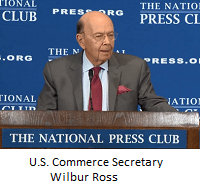 Asked
about President Donald Trump’s statements on Twitter this weekend about
helping Chinese telecom equipment manufacturer ZTE, U.S. Commerce
Secretary Wilbur Ross said Monday the department would review it —
quickly.
The U.S. Commerce Department last
month blocked American firms from selling parts or providing services to
ZTE. Ross explained to attendees at a National Press Club luncheon,
that ZTE violated U.S. sanctions against Iran and North Korea and the
Chinese telecom manufacturer agreed to pay a $1.2 billion fine. But the
former bankruptcy specialist said the U.S. found out ZTE didn’t live up
to the agreement. “It turned out a number
of statements ZTE made to us were not accurate. Our initial thought was
to impose the ‘bad list’ so the company can’t receive high tech
material. That’s what led to the shutdown,” Ross said.
ZTE essentially stopped all
operations last month because of the ban and was working to get it
reversed, the company said in an investment filing last month, Inside Towers
reported. Sunday, Trump tweeted that he’s working to give ZTE “a way to
get back into business, fast” because “too many” Chinese jobs were at
risk. He added he’s “instructed” the Commerce Department to help ZTE,
reported CNN. Continue Reading
Asked
about President Donald Trump’s statements on Twitter this weekend about
helping Chinese telecom equipment manufacturer ZTE, U.S. Commerce
Secretary Wilbur Ross said Monday the department would review it —
quickly.
The U.S. Commerce Department last
month blocked American firms from selling parts or providing services to
ZTE. Ross explained to attendees at a National Press Club luncheon,
that ZTE violated U.S. sanctions against Iran and North Korea and the
Chinese telecom manufacturer agreed to pay a $1.2 billion fine. But the
former bankruptcy specialist said the U.S. found out ZTE didn’t live up
to the agreement. “It turned out a number
of statements ZTE made to us were not accurate. Our initial thought was
to impose the ‘bad list’ so the company can’t receive high tech
material. That’s what led to the shutdown,” Ross said.
ZTE essentially stopped all
operations last month because of the ban and was working to get it
reversed, the company said in an investment filing last month, Inside Towers
reported. Sunday, Trump tweeted that he’s working to give ZTE “a way to
get back into business, fast” because “too many” Chinese jobs were at
risk. He added he’s “instructed” the Commerce Department to help ZTE,
reported CNN. Continue Reading

