UPDATE
A federal appeals court yesterday denied a motion to stay an FCC order
to ease wireless infrastructure siting by exempting most small cells on
non-Tribal lands from environmental and historic review.
The Seminole Tribe of Florida most
recently asked the D.C. Circuit for a stay, pending the court’s review
of the Tribe’s Petition for Review. The Seminoles joined with 15 other
tribes, plus the Natural Resources Defense Council and the National Trust for Historic Preservation in the United States
in fighting the FCC, saying the agency did not properly consult with
Tribes before adopting the order in March and its decision violated
federal law. The Seminoles said in their
July 18 motion the decision: “effectively eliminates the Tribe’s ability
to collect fees for its review of macro cell towers and gives industry
applicants the discretion to contract important review and mitigation
work to non-tribal entities unqualified to protect the Tribe’s historic
and cultural properties.”
The order was due to go into effect July 2. Sprint and CTIA recently joined the FCC in the case, Inside Towers
reported last week. The Commission consistently said it consulted with
the Tribes before making the change and did not violate federal law. Continue Reading

Written for the wireless tower industry.
Thursday, August 16, 2018

Wednesday, August 15, 2018
New OTMR Rules Still Come Up Short for Tower Industry

The FCC confined its new One-Touch, Make-Ready rules to simple pole attachment work. Utilities and attachers told the Commission this will apply to most of the upcoming pole work. The agency also updated its other pole attachment rules in the Report and Order. (See more about what the new OTMR rules entail further down.)
Like the BDAC, it defines complex make-ready as: “transfers and work within the communications space that would be reasonably likely to cause a service outage(s) or facility damage, including work such as splicing of any communication attachment or relocation of existing wireless attachments.” Complex work is not part of OTMR “at this time,” says the agency in the order. Continue Reading
Monday, August 13, 2018
Some Small Contractors Turn to Utilities for Faster Payment
UPDATE
As we hear from more readers experiencing late payment terms affecting
smaller contractors asked to do tower and network work, a new theme is
emerging — diversification. As a way to buffer their cash flow against
late payment from some in the telecom industry, certain readers tells us
they’re taking work from other types of industries to keep their
businesses afloat.
One contractor in the southeast told Inside Towers in an interview: “For three years, I have experienced the dreaded year-end non-payment issue with the same carrier. We have to make contingency plans with our financial institution, assuming we may not receive any payments during the latter half of the fourth quarter. It all gets paid in mid-January.”
He has begun taking different types of work because, “Somebody dragging out $300,000 over 90 to 120 days can be death. You lose vendors and employees” that way, he said. Continue Reading
One contractor in the southeast told Inside Towers in an interview: “For three years, I have experienced the dreaded year-end non-payment issue with the same carrier. We have to make contingency plans with our financial institution, assuming we may not receive any payments during the latter half of the fourth quarter. It all gets paid in mid-January.”
He has begun taking different types of work because, “Somebody dragging out $300,000 over 90 to 120 days can be death. You lose vendors and employees” that way, he said. Continue Reading
Wednesday, August 8, 2018
FirstNet Unveils Emergency Drop Kit to “Hotshot Crews”
APCO Interview
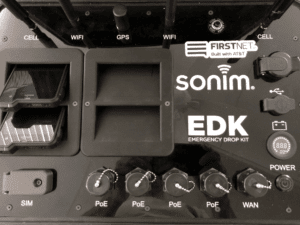

AT&T has been deploying Band 14 public safety spectrum as part of its FirstNet build. Band 14 has been added to more than 2,500 tower sites, with an additional 10,000 sites to be added by year-end, Ryan Fields-Spack Director, Public Safety Strategies, FirstNet tells Inside Towers from the show floor of the Association of Public-Safety Communications Officials show in Las Vegas.
One of the items on display as a proof of concept is an Emergency Drop Kit, a collaboration of FirstNet, AT&T and Sonim. The kit is designed to be carried by first responders into disaster areas that trucks can’t immediately drive into, like where a “hotshot crew” is fighting wildfires, says Fields-Spack. Incident commanders will be able to drop in the kits for rapid connectivity to FirstNet. FirstNet is in booth 836 at this week’s APCO 2018 Conference & Expo, which runs through today.
Continue Reading
AT&T has been deploying Band 14 public safety spectrum as part of its FirstNet build. Band 14 has been added to more than 2,500 tower sites, with an additional 10,000 sites to be added by year-end, Ryan Fields-Spack Director, Public Safety Strategies, FirstNet tells Inside Towers from the show floor of the Association of Public-Safety Communications Officials show in Las Vegas.
One of the items on display as a proof of concept is an Emergency Drop Kit, a collaboration of FirstNet, AT&T and Sonim. The kit is designed to be carried by first responders into disaster areas that trucks can’t immediately drive into, like where a “hotshot crew” is fighting wildfires, says Fields-Spack. Incident commanders will be able to drop in the kits for rapid connectivity to FirstNet. FirstNet is in booth 836 at this week’s APCO 2018 Conference & Expo, which runs through today.
Continue Reading
Friday, August 3, 2018
FCC Makes One-Touch Make-Ready a Reality


FCC Commissioners Michael O’Rielly, Brendan Carr and Jessica Rosenworcel
The FCC passed a one-touch make-ready (OTMR) policy for utility pole attachments yesterday, saying the update will speed the safe and affordable deployment of broadband wireless infrastructure. The change will allow one attacher, usually the last, to perform all the work for the new attachment; it provides for a remedy if an original attacher is unhappy with the outcome.
Pole overlashing of existing wires is allowed, without first seeking the utility’s approval, so all pole space can be efficiently used. It ensures telecoms pay rates comparable to cable and other industries for pole use. The Report and Order makes clear the FCC will preempt, on a case-by-case basis, existing local laws, to allow providers access to poles for restoration work after a disaster.
A declaratory ruling emphasizes the Telecommunications Act bans state and local moratoria that prevents wireless infrastructure deployment. Commissioner Michael O’Rielly said during the vote that while many localities “get kudos” for making the broadband deployment process more efficient, some state and local governments delay projects and use pole attachment rates as “shakedown bounties.” He said: “State and local governments have been on notice for decades. Congress wants them to stop making decisions based on aesthetics.”
(For industry reaction, see story below: “Industry Applauds FCC ‘Keeping Foot on The Gas’ for OTMR”) Continue Reading
Thursday, August 2, 2018
Contractor Fears Going Under Due to Late Payment Issue
UPDATE Inside Towers received an anonymous letter in response to our recent story (“The Check is Not in the Mail”) concerning
allegations that larger companies have extended payments to tower
contractors to the breaking point, offering as much as 120-day “take it
or leave it” terms. Smaller contractors assert they’re being used as a
bank and those terms can be crippling.
The writer said he is a Verizon contractor and afraid to reveal his name for fear of losing future work. “Many of us small contractors are about to close our doors due to the intimidation and practices on payments from these major carriers,” he writes. The individual alleged Verizon is asking contractors to build this year, but not invoice them, nor whatever company hired them for the carrier work, until 2019. He also asserted through its “Minor Materials Program,” the carrier is now expecting contractors to source, pay for, insure and warehouse materials that it used to provide.
A Verizon spokesman said he couldn’t comment on the details specifically. Verizon Director of Corporate Communications Bob Varettoni told Inside Towers in an interview that in general, the company’s long-standing payment term is 90 days and 30 days for construction projects. However, he said: “Verizon is committed to doing the right thing and following sound business practices in dealing with our suppliers.” To illustrate his point, Varettoni offered to help the anonymous letter writer. Continue Reading
The writer said he is a Verizon contractor and afraid to reveal his name for fear of losing future work. “Many of us small contractors are about to close our doors due to the intimidation and practices on payments from these major carriers,” he writes. The individual alleged Verizon is asking contractors to build this year, but not invoice them, nor whatever company hired them for the carrier work, until 2019. He also asserted through its “Minor Materials Program,” the carrier is now expecting contractors to source, pay for, insure and warehouse materials that it used to provide.
A Verizon spokesman said he couldn’t comment on the details specifically. Verizon Director of Corporate Communications Bob Varettoni told Inside Towers in an interview that in general, the company’s long-standing payment term is 90 days and 30 days for construction projects. However, he said: “Verizon is committed to doing the right thing and following sound business practices in dealing with our suppliers.” To illustrate his point, Varettoni offered to help the anonymous letter writer. Continue Reading
Wednesday, August 1, 2018
USDA Seeks Input on Rural Broadband Funding Pilot

The U.S. Department of Agriculture (USDA) is asking for suggestions about how to implement the e-Connectivity Pilot Program, which would involve public-private partnerships to deploy broadband in rural areas. The framework outlined by Congress allows $600 million in new federal funds to be deployed in rural areas with a population of 20,000 or less. Entities eligible for funding include incumbent and competitive rural telephone and broadband service providers, rural electric cooperatives, private firms (but not sole proprietors or partnerships), nonprofits and governmental bodies.
Rural areas that don’t have internet service speeds of at least 10 megabits per second (Mbps) download and 1 Mbps upload available to their households will be eligible to apply for the money. The USDA seeks input on the best options to verify broadband speeds and potential project benefits for rural industries such as agriculture, manufacturing, e-commerce, transportation, health care and education, using readily available public data. The USDA is specifically interested in how to make the most effective use of these new funds through utility partnerships. Continue Reading
Subscribe to:
Posts (Atom)